
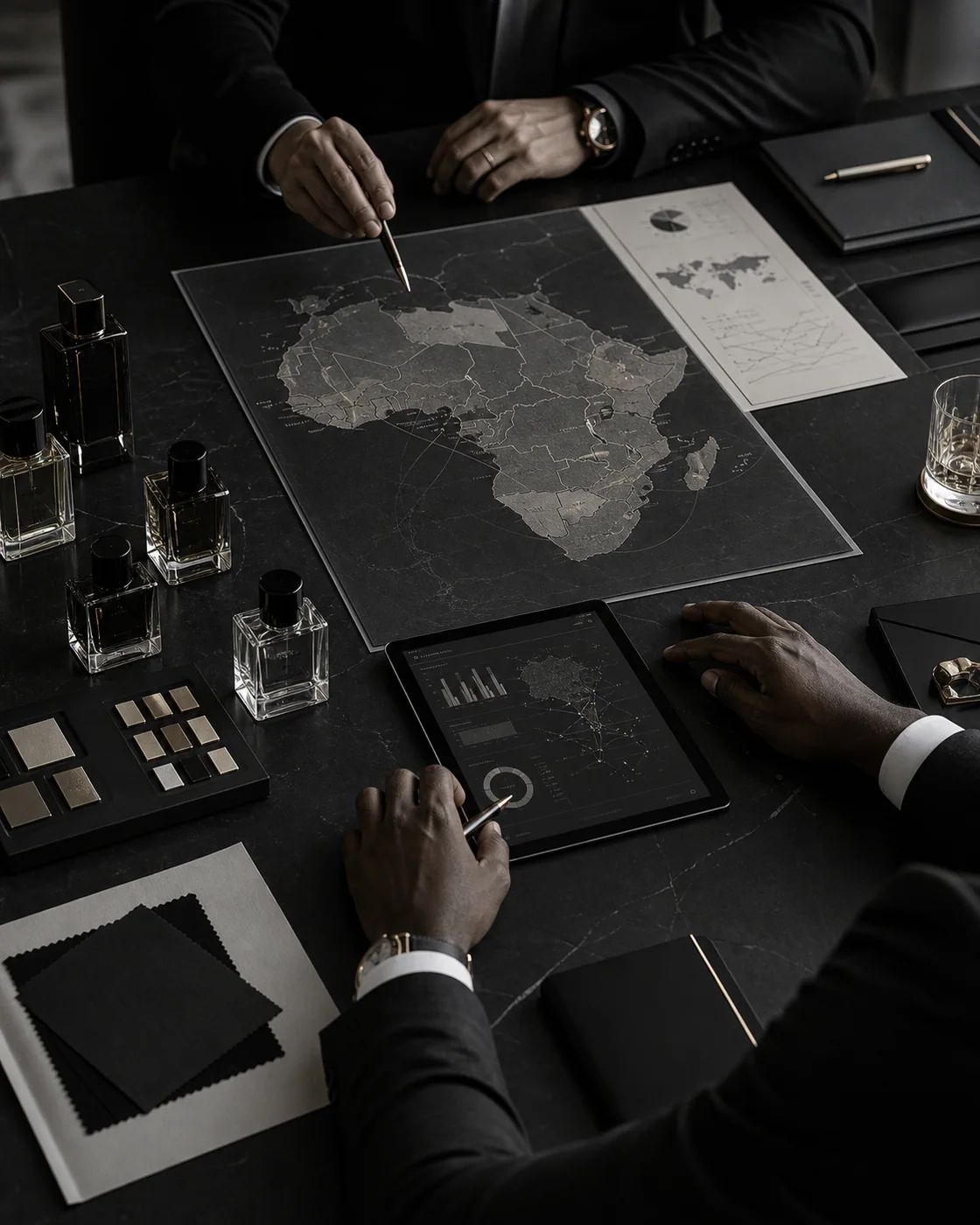
To a fragrance executive sitting in Paris, Milan or Dubai, the map of Africa can look wonderfully clean. There are countries, capitals, population figures and growth forecasts. Colour in the promising territories, add a few arrows and the beginnings of a strategy appear.
This neatness survives right up to the first shipment.
The real fragrance market is messier. Demand gathers inside particular cities, shopping districts, retail groups and social circles. A country may look quiet from thirty thousand feet while a few neighbourhoods below are buzzing with collectors, travellers and customers who know exactly what they want.
The opportunity is already there. The map is simply zoomed out too far.
The average customer does not exist
National statistics describe millions of people by blending them into one imaginary consumer. This person earns the average income, spends the average amount and lives somewhere in the mathematical middle of the country.
Nobody has ever met them.
A report from Google and the International Finance Corporation found that spending in Africa's large metropolitan areas was typically 79 per cent higher than the national average. Cities concentrate income, travel, modern retail and cultural influence. They also compress discovery. A customer smells a fragrance at dinner, asks about it, searches for it that evening and visits a store the following weekend.
National averages are a satellite photograph. You can see the country; you miss the street.
Lagos has its own weather
A recent account of fragrance culture in Lagos described perfume as an increasingly personal status symbol. The appeal is easy to understand. A bottle allows someone to enter the world of an international Maison without buying a watch, handbag or couture jacket.
The city is also developing its own language around scent. Collectors compare performance in the Lagos heat. Customers research notes and houses online. Local retailers sell through Instagram, websites, WhatsApp and long conversations about which bottle will survive a humid evening.
Then there are the launches. When Clive Christian introduced a collection through an immersive fragrance and dining experience in Lagos, the city served as part of the story. Lagos carries cultural gravity; music, fashion and entertainment already travel outward from it.
A brand entering Nigeria should understand that gravity. Population size alone will never explain it.
The first door sets the temperature
The first retailer becomes the front door of the Maison. It establishes the price, controls the presentation and introduces the collection to customers who may remember that encounter for years.
This is why door count can become a vanity metric. Fifty weak doors create fifty opportunities for the brand to look forgotten. A smaller group of committed retailers can create theatre, curiosity and trust.
The question is simple: can this retailer make someone care?
A good partner keeps testers available, trains advisers and understands when to give a customer space. They also return valuable information. Which fragrance starts the conversation? Which bottle reaches the skin? Which price creates hesitation? The shop floor speaks every day; smart brands listen.
The internet gets there first
Africa had around 416 million mobile internet users in 2024. A consumer can discover a fragrance in London, watch a reviewer in New York and ask a retailer in Nairobi about availability before breakfast.
Demand sometimes arrives like guests turning up while the table is still being set.
This creates an opening for official distribution. It also leaves room for grey-market products, confusing prices and questions about authenticity. In Nigeria, some retailers openly describe trust as one of the fragrance market's central problems.
Brands should watch where online attention becomes local enquiry. That trail can lead directly to the cities ready for investment.
Start with the living map
Space believes African expansion should begin with the places where demand has a pulse.
Choose the cities. Find the retailers capable of representing the Maison. Build the right assortment. Train the people standing beside the bottle. Watch what customers smell, ask and buy.
The country strategy provides the skeleton. Cities put flesh on the bones.